India records a major decline in extreme poverty
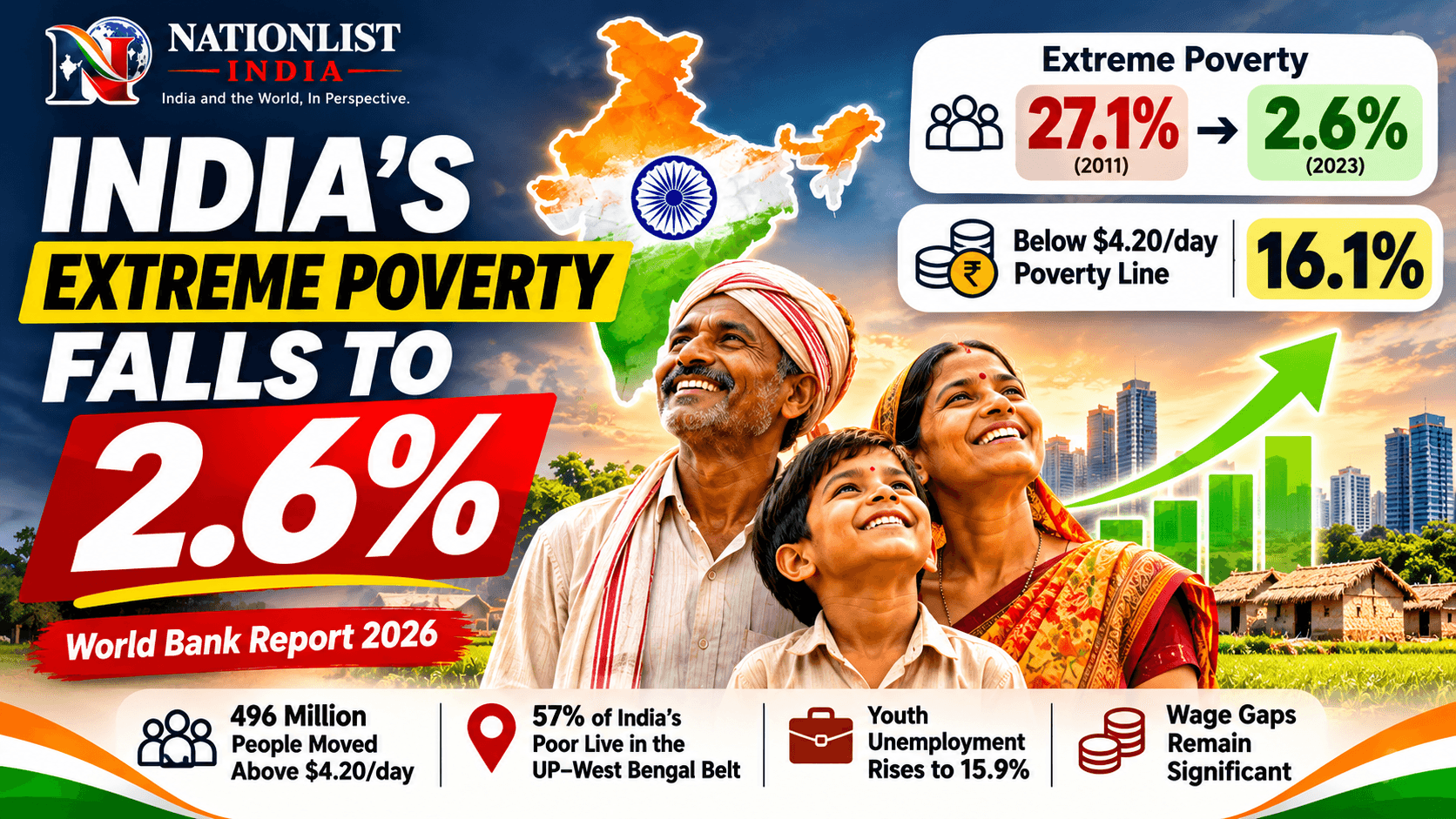
India’s extreme poverty rate fell from 27.1% in 2011 to 2.6% in 2023, according to the World Bank’s October 2026 Poverty & Equity Brief. The report estimates that approximately 496 million people moved above the lower-middle-income poverty threshold during this period.
Understanding the two poverty figures
The 2.6% figure uses the World Bank’s international extreme-poverty threshold of $3 per person per day, measured at 2021 purchasing power parity (PPP). At the higher lower-middle-income threshold of $4.20 per person per day, India’s poverty rate declined from 57.7% to 16.1% over the same period. These are different thresholds and should not be confused.
What contributed to poverty reduction?
The assessment points to stronger household consumption, increased employment and expanded social support. Employment increased by approximately 134 million people between 2017 and 2023, with rural women entering paid employment contributing to the expansion. Food subsidies and other social transfers also supported household consumption.
Poverty remains geographically concentrated
The World Bank estimates that approximately 57% of India’s poor population lives in a contiguous belt extending from Uttar Pradesh to West Bengal. Rural poverty under the $4.20 threshold stood at 19.3% in 2023, compared with 8.6% in urban areas.
Youth unemployment and wage inequality remain concerns
The report highlights concerns about job quality and opportunities for young people. Youth unemployment increased from 14.6% to 15.9% between the reporting periods cited in the assessment. It also notes that median earnings among the top 10% of workers were approximately 13 times those of the bottom 10% in 2023.
Multidimensional poverty also declined
The report notes that the Oxford Poverty and Human Development Initiative’s Multidimensional Poverty Index declined from 53.8% in 2005–06 to 16.4% in 2019–21. The World Bank’s own multidimensional poverty measure stood at 15.5% in 2022–23.
Outlook
The World Bank’s indicative projections suggest that poverty under the $4.20-per-day threshold could decline from 14.2% in 2026 to 12.1% by 2028. These are model-based projections, not confirmed future outcomes.
India’s next challenge
The decline in extreme poverty represents substantial progress in measured household welfare. However, rural poverty, regional concentration, youth unemployment and wage inequality remain significant challenges. Sustaining progress will require productive jobs, higher incomes and broader access to economic opportunities.
Source: World Bank, Poverty & Equity Brief – India, October 2026.