Israel Election 2026: Netanyahu’s Right-Wing Bloc Leads, but Did the Far Right Really Win?
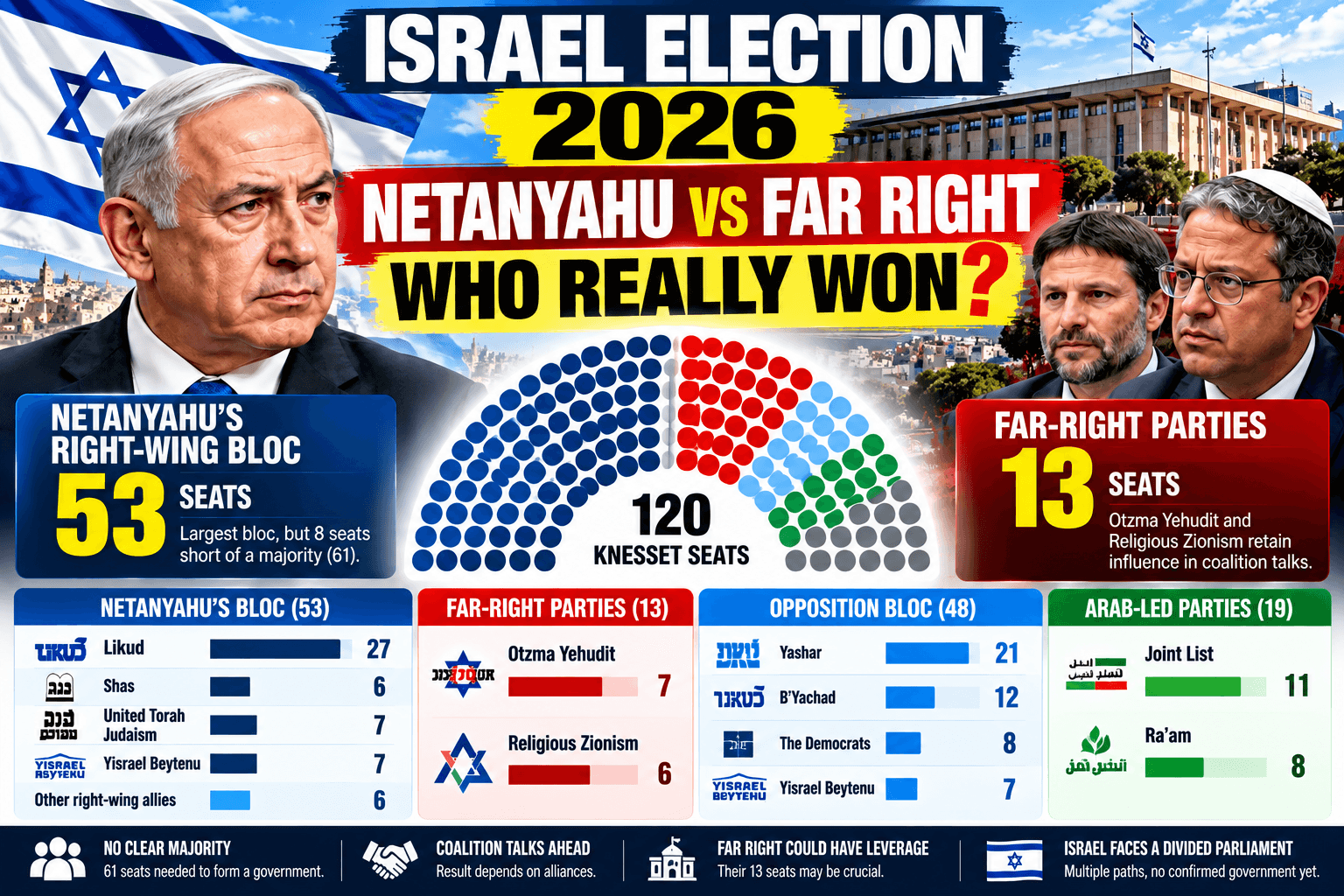
Israel’s 2026 general election has produced a divided parliament. Benjamin Netanyahu’s bloc finished ahead with 53 seats, while far-right parties secured 13 seats within that bloc. The 120-seat Knesset requires 61 seats for a parliamentary majority, and no single political grouping has reached that threshold.
Netanyahu’s bloc finishes ahead
Likud, led by Benjamin Netanyahu, emerged as the largest single party with 27 seats. Netanyahu’s broader bloc has 53 seats in total: Likud (27), Shas (6), United Torah Judaism (7), Otzma Yehudit (7) and Religious Zionism (6). These figures add up to 53.
The far-right parties Otzma Yehudit and Religious Zionism account for 13 of those 53 seats. They are already included in Netanyahu’s bloc total and must not be added to it again. The bloc is eight seats short of the 61 needed for a majority.
The far right: 13 seats and potential influence
Otzma Yehudit, led by Itamar Ben-Gvir, won seven seats. Religious Zionism, led by Bezalel Smotrich, secured six. Together they hold 13 seats. Their position within Netanyahu’s camp could give them bargaining power in coalition negotiations, but they did not win 13 seats separately from the 53-seat bloc.
The opposition: 48 seats
The opposition grouping led by Gadi Eisenkot secured 48 seats: Yashar (21), B’Yachad (12), The Democrats (8) and Yisrael Beytenu (7). These four party totals add up to 48.
Arab-led parties: 19 seats
The Joint List won 11 seats and Ra’am secured eight, giving Arab-led parties 19 seats in total. Their representation could prove important in negotiations over the next government.
Full party-by-party count: 120 seats
The reported party results add up as follows: Likud 27; Yashar 21; B’Yachad 12; Joint List 11; The Democrats 8; Ra’am 8; Yisrael Beytenu 7; United Torah Judaism 7; Otzma Yehudit 7; Shas 6; and Religious Zionism 6. The arithmetic is 27 + 21 + 12 + 11 + 8 + 8 + 7 + 7 + 7 + 6 + 6 = 120 seats.
The bloc-level cross-check is also exact: Netanyahu’s bloc 53 + opposition grouping 48 + Arab-led parties 19 = 120. Within the 53-seat Netanyahu bloc, the 13 far-right seats are a subset, not an additional bloc.
So, who really won: Netanyahu or the far right?
Netanyahu’s broader right-wing bloc finished with the most seats, but it did not secure a majority. The far-right parties won 13 seats within that bloc and could have significant influence if their support is needed to form a government. The opposition has 48 seats, while Arab-led parties have 19.
The opposition grouping and Arab-led parties together account for 67 seats on paper, but this does not automatically create a governing coalition. Political disagreements and the conditions for cooperation remain significant obstacles.
What happens next?
The results leave Israel facing coalition negotiations. Netanyahu could seek to rebuild a government with his existing partners. Other possibilities include a broader unity arrangement or attempts by the opposition to secure support from Arab-led parties. The key question is which combination can command the support of at least 61 members of the Knesset.
The bottom line: Netanyahu’s bloc leads with 53 seats; far-right parties hold 13 of those seats; the opposition grouping has 48; and Arab-led parties have 19. All party totals and bloc totals reconcile to the Knesset’s 120 seats.