Hyderabad takes a step towards cleaner outer space
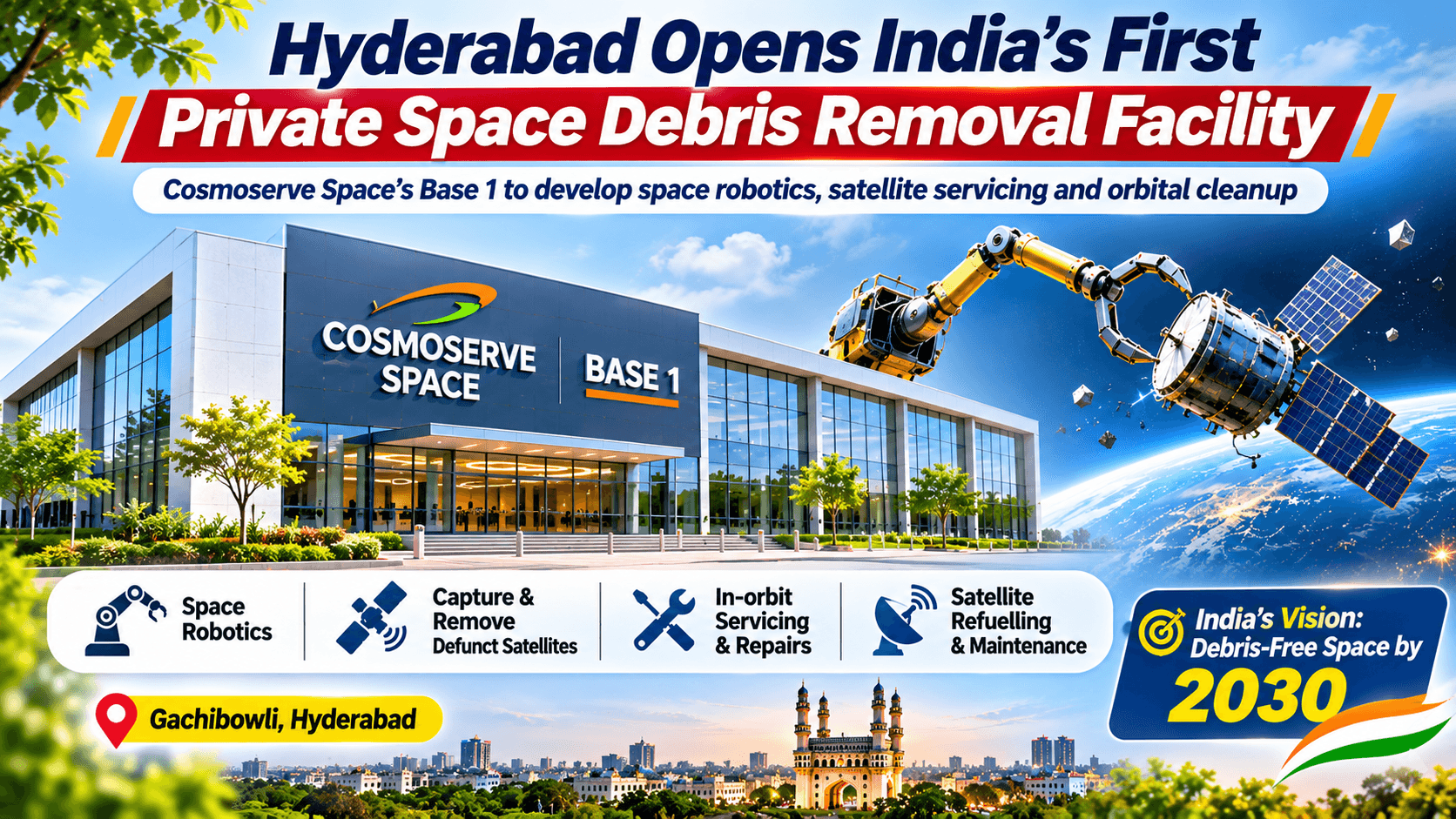
Hyderabad has taken another step towards strengthening India's private space technology ecosystem with the inauguration of Base 1, a specialised space robotics and satellite-servicing facility established by Cosmoserve Space in Gachibowli. The facility is designed to support the development, testing and operation of technologies for active space-debris removal and in-orbit satellite servicing.
What is Cosmoserve Space's Base 1 facility?
Spread across approximately 14,800 square feet at VSD Tech Park in Gachibowli, Base 1 brings several specialised capabilities together. These include an orbital rendezvous and capture laboratory, a space robotics innovation lab, microgravity simulation platforms, satellite integration clean rooms, and a mission simulation and control centre.
The facility is intended to help the company design, build and test technologies used to approach, inspect, capture and service spacecraft in orbit.
Why is space debris a growing concern?
Space debris includes defunct satellites, abandoned rocket stages and fragments created by collisions or explosions in orbit. Travelling at extremely high speeds, even small fragments can damage operational satellites and threaten spacecraft. As the number of satellites in orbit increases, managing debris is becoming an important challenge for the global space industry.
Active debris-removal technologies aim to capture or otherwise safely deal with selected defunct satellites and orbital objects. In-orbit servicing can also help extend the useful life of spacecraft through inspection, repairs and refuelling.
Cosmoserve's plans for satellite capture and servicing
Cosmoserve Space is developing technologies for active debris removal and in-orbit servicing. The company has outlined a dual-spacecraft architecture in which a larger orbital service station would act as a logistics hub, while smaller autonomous vehicles would travel to individual satellites to inspect, capture, repair or remove them.
The company's roadmap includes a full-scale debris-capture demonstration targeted for 2027 and commercial operations targeted for 2028. These are planned milestones, not completed operational capabilities.
Mission EMBRACE and earlier technology demonstrations
The company's development work includes Mission EMBRACE, which conducted an in-space test of soft robotic petals in July 2026. The mission was highlighted as an example of progress by India's emerging private space companies.
India's vision for debris-free space by 2030
At the facility's inauguration, Union Minister of State for Science and Technology Dr Jitendra Singh outlined India's vision of achieving debris-free space by 2030. He highlighted the importance of active debris removal and satellite servicing in maintaining a safe and sustainable orbital environment.