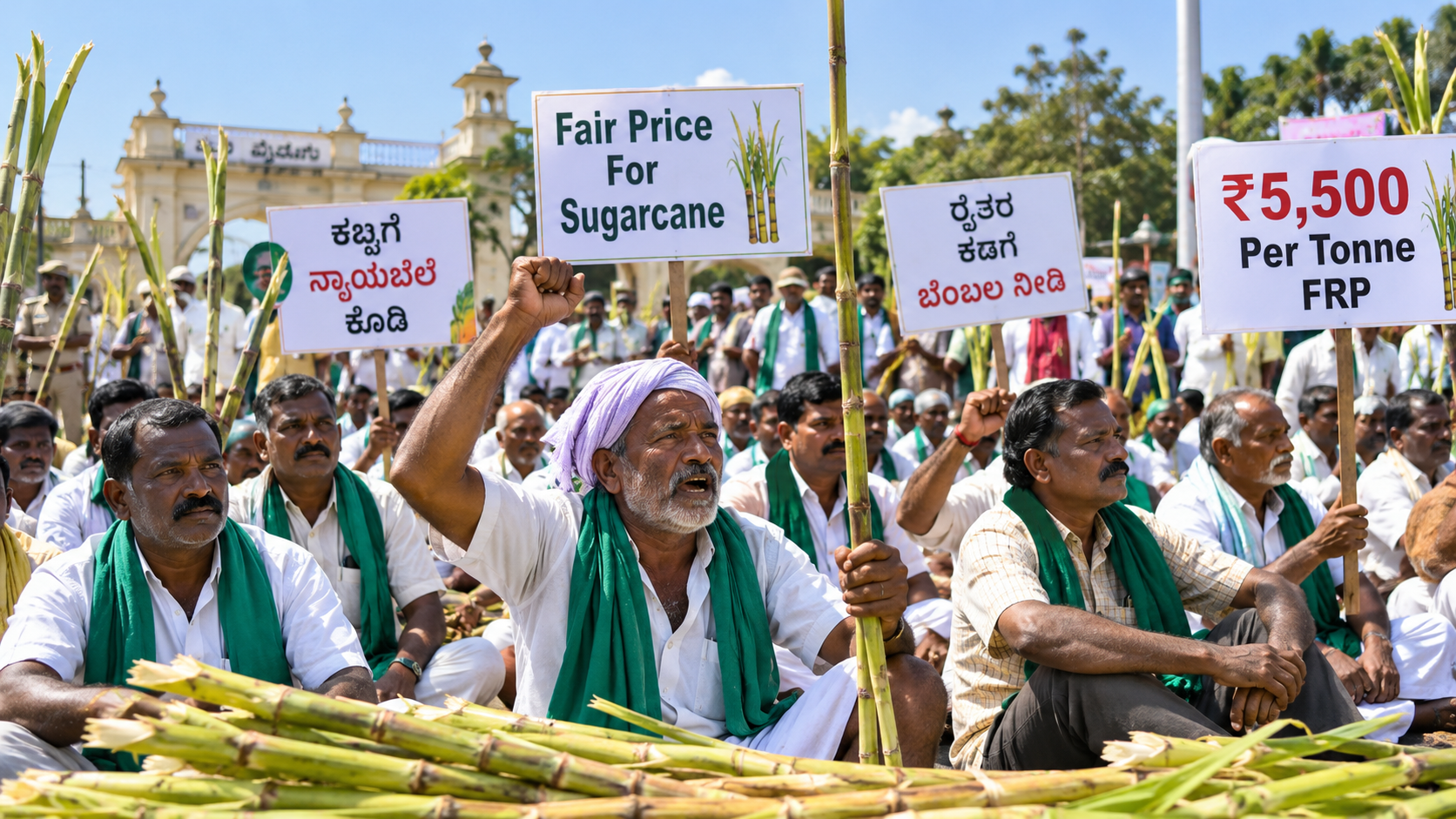
Mysuru, October 16: Sugarcane farmers in Karnataka are pressing for higher prices for their produce, with growers demanding ₹5,500 per tonne and seeking changes to how sugar mills calculate sugar recovery and weigh harvested cane.
The issue has drawn attention at both the state and central levels. On October 15, members of the Karnataka State Sugarcane Growers Association staged a protest near the Agricultural Produce Market Committee (APMC) office on the Mysuru–Nanjangud highway, according to a report published by The Times of India.
The farmers demanded a fair remunerative price (FRP) of ₹5,500 per tonne from the Union government. They also called for changes to Karnataka’s state advisory price and raised concerns about the sharing of revenue generated from sugarcane by-products.
Centre forms committee to examine farmers’ demands
The Union government has formed a committee led by former NITI Aayog member Ramesh Chand to examine sugarcane farmers’ concerns in Karnataka and Maharashtra, The Economic Times reported on October 14.
The committee will examine demands for higher remunerative prices and a revision of the minimum selling price of sugar. It will also look into the procedures used by sugar mills to test sugar recovery and weigh sugarcane supplied by farmers.
The panel’s work follows a meeting on October 12 involving Union Agriculture Minister Shivraj Singh Chouhan, Union Food Minister Pralhad Joshi and delegations representing sugarcane farmers from the two states.
According to the report, the committee is expected to consult farmers’ representatives, sugar mill associations, state governments and experts before submitting recommendations for consideration by the competent authority.
The formation of the committee does not mean that the farmers’ requested price has been approved. The demand remains subject to examination and a decision by the relevant authorities.
Why are farmers demanding a higher price?
Farmers have argued that cultivation expenses and the returns they receive from sugarcane need closer examination. Expenditure on labour, fertilisers, irrigation, harvesting and transportation can affect the financial outcome of a crop season.
Growers have also raised concerns about the value generated by sugar mills from products made during sugar processing. These include molasses and bagasse, while some mills also generate electricity or produce other products.
Farmers’ representatives have argued that the revenue generated from these activities should be considered when assessing the returns received by sugarcane growers.
The question of how such revenue should affect cane prices is part of the wider discussion over the financial relationship between growers and sugar mills. Any change to pricing arrangements would require consideration by the relevant authorities.
Sugar recovery and weighing practices under scrutiny
Beyond the price per tonne, farmers have raised questions about how mills measure the quantity and quality of sugarcane supplied to them.
Sugar recovery is an important factor in sugar production because it measures the amount of sugar obtained from processed cane. The committee is expected to examine existing testing and reporting systems and consider ways to improve transparency in verification.
Weighment practices are another concern. Accurate weighing is essential because it determines the quantity of cane recorded as supplied by a farmer and can influence the payment calculation.
The committee will also review weighment procedures, including the inspection and verification of weighing systems, as well as deductions associated with mechanically harvested sugarcane.
These issues are important to growers because pricing decisions alone may not resolve disputes if farmers and mills do not agree on the quantity weighed or the methods used to determine sugar recovery.
Farmers raise concerns over crop losses and loans
During the Mysuru protest, farmers also called for relief for growers affected by drought and crop losses. Their demands included a waiver of certain crop loans borrowed from cooperative and nationalised banks, as well as compensation for affected farmers.
The demands reflect concerns beyond sugarcane pricing, including the financial pressure that crop damage and uncertain agricultural conditions can place on rural households.
The specific relief measures sought by farmers should be distinguished from any assistance formally approved by the government. The protest report does not establish that a loan waiver or additional compensation has been sanctioned.
What happens next?
The next important step is the committee’s examination of farmers’ demands and its recommendations to the government. Its findings may help inform discussions about remunerative prices, sugar pricing, recovery testing and weighing practices.
Farmers will be watching whether their representatives are consulted and whether the review leads to practical changes in pricing and mill procedures.
For now, the demand for ₹5,500 per tonne remains a demand by farmers, rather than an announced government-approved rate. Any official change should be confirmed through a government announcement.
Sources: The Times of India, “Sugarcane growers protest in Mysuru, demand ₹5,500/tonne FRP,” October 15, 2026; The Economic Times, “Centre sets up Ramesh Chand-led panel to examine sugarcane farmers’ demands in Karnataka, Maharashtra,” October 14, 2026.