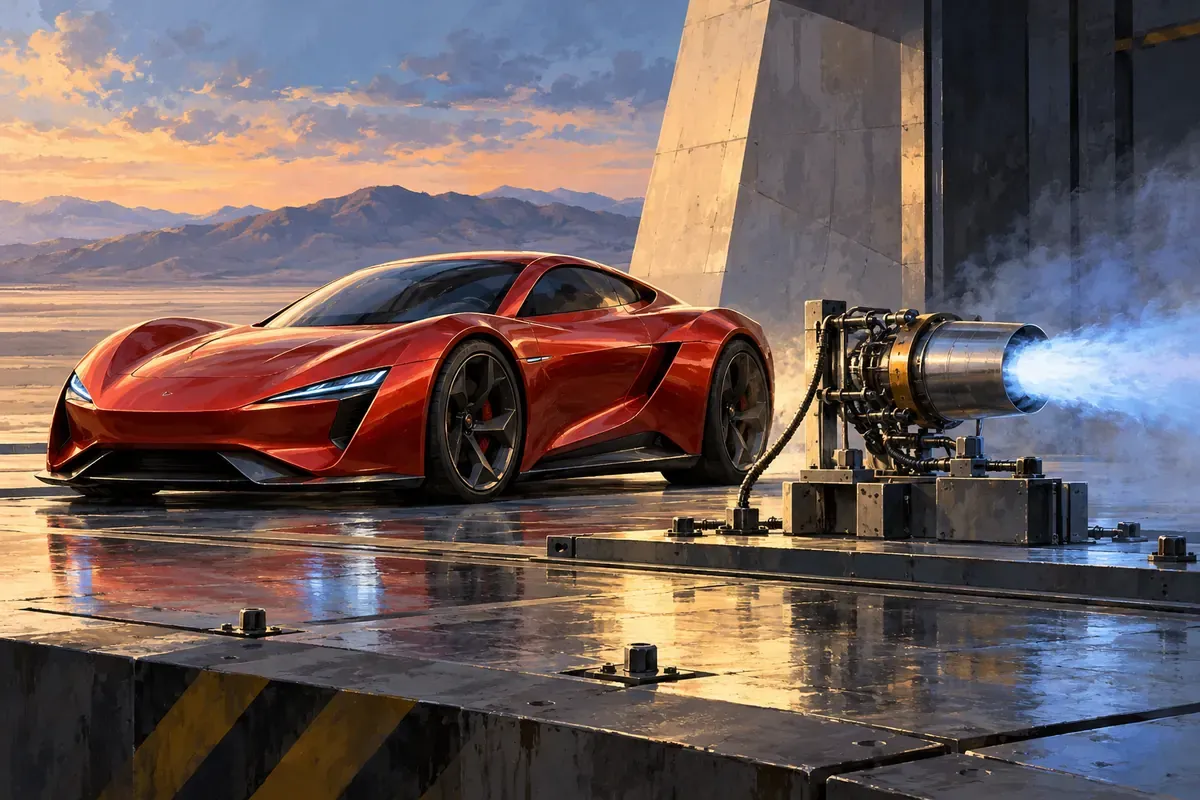
Tesla's latest Roadster demonstration has put an unusual engineering feature at the centre of the car's relaunch: cold-gas thrusters capable of producing brief airborne movement. The October 15 presentation at a SpaceX facility in Texas showed technology far beyond the conventional acceleration claims normally associated with an electric sports car.
The demonstration does not establish that a customer can legally use those movements on a public road. Tesla's own Roadster information distinguishes different configurations and says the Rocket version is not approved for public-road use. Availability is also subject to local legal requirements.
Different configurations, different claims
Tesla describes Performance, Thrust and Rocket offerings with different equipment and intended capabilities. Its descriptions associate the more extreme manoeuvring functions with the Rocket configuration, rather than every Roadster. Treating all of the demonstrated features as standard equipment would therefore misrepresent the company's own presentation.
The manufacturer's information also qualifies performance specifications and identifies optional upgrades. That matters when comparing acceleration figures or reservation offers. A number attached to one configuration cannot automatically be applied to another, and promotional claims remain distinct from independent testing of a customer production vehicle.
The Associated Press reported that consumer production was not expected to begin until 2028 and that reservation terms did not guarantee delivery. Those details make the event a product demonstration and future-production announcement, rather than evidence of an immediately available car that buyers can drive away.
What cold-gas thrust means
Cold-gas propulsion produces force by releasing pressurised gas through a nozzle. Unlike a combustion rocket engine, it does not need to burn fuel in a combustion chamber to create that flow. NASA's technical descriptions discuss the use of such systems for small spacecraft and manoeuvring applications.
The principle is familiar in aerospace, but its application to a road vehicle creates a different set of engineering questions. A spacecraft controlling its orientation and a heavy vehicle moving near the ground operate in very different environments. Demonstrating one movement does not answer every question about repeated use, control or nearby objects.
NASA's work also illustrates the physical equipment involved: storage, regulation and thrusters have to operate as a system. For a car, that means the gas supply and associated hardware are part of the design, in addition to the electric drivetrain. The presence of an electric battery does not make the stored-gas system irrelevant.
A demonstration is one stage of development
Aviation Week's report described the Roadster's short airborne manoeuvres and the combination of thrusters with a suction system. The footage attracted attention because it showed a car doing something very different from ordinary driving. The next engineering questions concern how the capabilities are controlled and under what conditions they are intended to operate.
For a potential customer, repeatability matters as much as spectacle. A demonstration establishes what a particular vehicle did in a particular setting. It does not provide a complete account of maintenance, replenishment, operating restrictions or the experience of an owner using the vehicle over time.
Those are open product questions, not evidence that the technology cannot work. They simply mark the difference between a successful presentation and a mature consumer offering. Published specifications, completed approvals and production documentation will be needed to assess the final vehicle on a consistent basis.
What prospective buyers should watch
The most useful next information would be final configuration details, pricing, production timing and the terms attached to each version. Independent performance tests would help distinguish company claims from results obtained outside the launch environment. Approval information would clarify where particular capabilities may legally be used.
For Indian readers, the global demonstration does not establish an India launch, local price or permission to operate the Rocket configuration on Indian roads. Those would require separate announcements and applicable approvals. Importing a headline from an overseas unveiling cannot answer those market-specific questions.
The Roadster event is a notable demonstration of Tesla's attempt to combine automotive and aerospace ideas. Its commercial significance will depend on the vehicle that reaches customers, the restrictions attached to it and whether the promised production schedule is met. The airborne display is the beginning of that assessment, rather than its conclusion.